Tech allows scientists to confirm new octopus species without the need for dissection
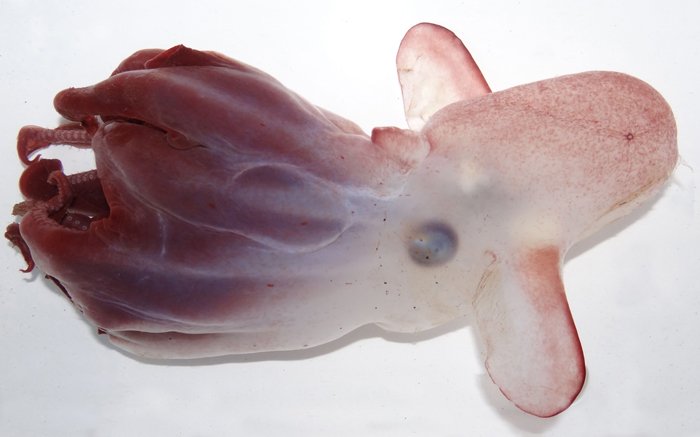

Image courtesy of Dr. Alexander Ziegler

Discovering a potential new animal species is exciting. But to confirm their thoughts, scientists typically need to perform a dissection, essentially killing the specimen. However, MRI and CT scan technologies could provide another option.

Introducing dumbo…

Introducing dumbo…

Back in 2016, scientists from Germany's University of Bonn found what they believed to be a new species of dumbo octopus. These octopuses are so named because of the fins on their heads look like elephant ears.

The 30cm long creature was captured in a basket on the seabed of the North Pacific Ocean, some 4,000 metres deep. Unfortunately, because of the sudden change of water pressure, it experienced while it was being winched to the surface, the octopus died.

Because the scientists y only had the one specimen, they wanted to keep it intact. However, they also wanted to look inside of it to determine if it really was a new species.

So the scientists performed an MRI (magnetic resonance imaging) scan on the creature. This allowed them to see its internal organs and other soft tissues in a series of high-resolution 3D images. But because the octopus’ beak and rasping tongue were made of a hard substance known as chitin, they didn't show up very well on the scan. The scientists overcame this problem by performing micro-CT (computed tomography) scans, which are better for imaging hard materials. They then sequenced the animal’s DNA from a tissue sample that was taken when it was captured.

The new emperor

The new emperor

Upon analysing all the data, the scientists were able to determine that the dumbo octopus was indeed a new species. The creature has been named Grimpoteuthis imperator, which is Latin for "Emperor dumbo". The name pays homage to the fact it was caught near Japan on an underwater mountain range, the peaks of which are named after Japanese emperors.

Still, in one piece, the specimen can now be examined by other biologists. Furthermore, a "crisp digital copy" of the specimen can be downloaded from the online MorphoBank database*.

"Our non-destructive approach could set a precedent, especially for rare and valuable animals," said lead scientist Dr. Alexander Ziegler.

A paper on the research has been published in the journal BMC Biology**.

* https://bmcbiol.biomedcentral.com/articles/10.1186/s12915-021-01000-9
** https://morphobank.org/

5 Tips to Help You Ace Online Job Interviews

April 27, 2020

While the current COVID-19 outbreak has caused a lot of uncertainty and economic turmoil, there are companies out there that are still hiring at the moment. But with staying at home now the new temporary norm, many recruiting managers have taken to conducting online interviews instead of the more traditional face-to-face kind.

4 Ways to Use the Time Right Now to Up Your Job Hunting Game

April 15, 2020

The ongoing COVID-19 outbreak means most people are at home wondering how everything is going to eventually play out. The lack of a daily commute also means most of us have more time on our hands right now than ever before. So if you’ve been considering looking for a new job, this could be the opportunity you’ve been waiting for.

Japanese Team Develops Plant-based Plastic That Biodegrades in the Ocean

March 30, 2020

Unless we do something radical, by 2050, there will be more plastic in the ocean (by weight) than fish. That was the stark warning issued in a report by the Ellen MacArthur Foundation back in December 2017.

Cambridge Attracted More Tech Investment than London in 2019

March 23, 2020

Cambridge attracted four times as much tech investment as London in 2019, further highlighting how the university city is quickly emerging as the UK’s Silicon Valley, new figures show.

Cambridge Scientists Develop World First App to Aid Type 1 Diabetes Management

March 20, 2020

Scientists from the University of Cambridge have developed a smartphone app to significantly ease the burden of living with type 1 diabetes.

New Supercapacitor Could Lead to Electric Vehicles Charging in Just 10 Minutes

February 29, 2020

Supercapacitors charge almost instantly and have much longer lifespans than Li-ion batteries, but they typically can only store tiny amounts of power. Batteries, on the other hand, can hold large amounts of power, but take ages to fully charge – one of the biggest challenges with electric vehicles.

British Biotech Firm Releases GM Moths to Help Curb Crop Damage

February 29, 2020

Scientists have created a genetically modified (GM) male diamondback moth in an attempt to dramatically curb the billions of pounds worth of damage it wreaks every year on crops.

World's Strongest Robotic Hand Can Gracefully Play the Piano with Its Human-like Fingers

February 24, 2020

With enough strength to handle objects three times its own weight, the robotic hand below is touted as the “world’s strongest” by its makers. However, it’s not all about strength, as this robotic hand is gentle and dexterous enough to gracefully play a piano, serve a glass of water and even hold eggs.

Top Tech Job Hunting Tips for 2020

January 28, 2020

January is a popular month for job seekers, as individuals use the start of the New Year to look at their current career paths and contemplate whether they want to change them.

Introducing Wahu: The Adaptive Sole for your Shoes

January 28, 2020

From smart watches to fitness trackers to smart glasses and more, wearable tech has firmly established itself as a significant part of our lives. But how far will it all go? How about some ‘smart’ adaptive soles for your shoes!? Here’s Wahu…

MarsCat: The Interactive Robotic Pet for Feline Fans

December 30, 2019

It’s more than 20 years since Sony’s Aibo robotic dog was released (yes, it was really that long ago!) and a recent reboot of the lovable ‘pet’ proved that interactive companions are still popular. But what if you’re more of a cat person?

From Tiny David to Impressive Building: Is There Anything 3D Printing Can't Do?

December 24, 2019

Are there any limits to what can and cannot be made using a 3D printer? Apparently not when you consider the two amazing creations we’re about to tell you about.

Follow Us

Contact