New Five-story Lab and Office Building to Rise at Cambridge Biomedical Campus
A new five-storey laboratory and office building will rise at the Cambridge Biomedical Campus after plans for its construction were approved by councillors.
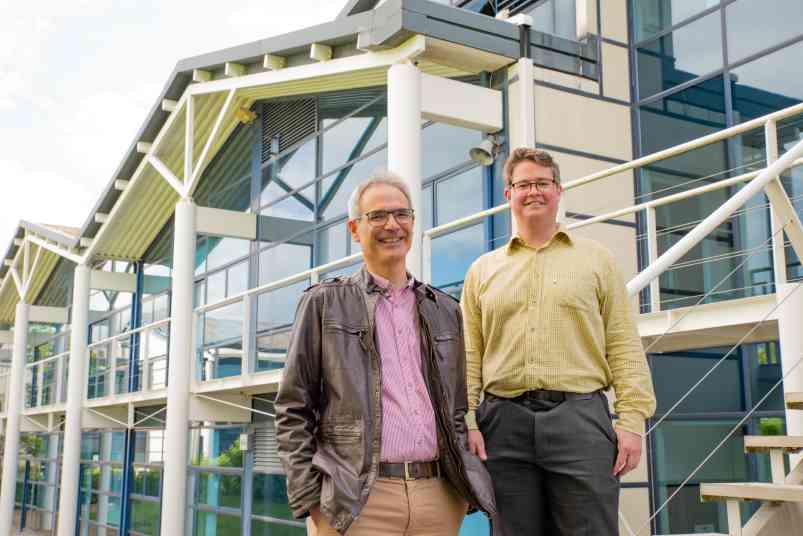
Forefront RF co-founders, Julian Hildersley (left) and Leo Laughlin (right) at their office in Cambridge, UK. Credit: Forefront RF.
A Cambridge semiconductor startup is looking to capitalise on the growing demand for sleek, region-specific smartphones with its innovative, frequency agile, tunable RF front-end chip.
According to Gartner*, global smartphones sales are estimated to hit 1.5 billion units this year. Gartner says faster connectivity, higher-quality cameras and longer battery life will drive this increased demand. But all of these features can come at the detriment of a smartphone’s design, particularly its sleekness.
Add to this the fragmented mobile spectrum, which sees more than 70 different frequency bands used around the world, and it is increasingly difficult for a smartphone manufacturer to make a unit that covers a multitude of geographic regions and keep the design appealing.
With this mind, Forefront RF**, a Cambridge-based fabless semiconductor startup, has entered the smartphone market, looking to negate the need for multiple RF components in a single handset.
Forefront RF has developed a frequency agile, tunable RF front-end chip that enables a device to access multiple mobile handset frequency bands.
In an interview with EE Times Europe, Leo Laughlin, co-founder of Forefront RF said the need for multiple RF components not only consumes more space inside the device, but also "adds cost and leads to inefficiencies in the supply chain.”
To help further its ambitions, Forefront RF has secured £1.5 million in its first funding round, led by led by Bristol-based Science Creates Ventures.
Forefront RF says the funds will be used to recruit a world-class team to accelerate the launch of its products. The firm expects to double its team to 10 people by the end of the year, looking to recruit engineers with experience in RF system architecture, software algorithms, and physical design and layout.
Founded in 2020 by Dr Leo Laughlin, Julian Hildersley and Phil O’Donovan, Forefront RF is looking to change the way global smartphones, wearables and IoT Devices are designed. The company’s revolutionary chip enables connected devices to operate across the increasingly wide range of 3G to 6G mobile telephony frequency bands.
“The growth in mobile networks driven by the ever-increasing demand for data means that available frequency bands vary from region to region and, using today’s technology, has driven the need for region-specific smartphone variants each including multiple RF components,” said Laughlin.
* https://www.gartner.com/en/newsroom/press-releases/2021-02-03-gartner-says-worldwide-smartphone-sales-to-grow-11-percent-in-2021
** https://www.forefrontrf.com/

A new five-storey laboratory and office building will rise at the Cambridge Biomedical Campus after plans for its construction were approved by councillors.
According to the World Mosquito Program, nearly 700 million people contract mosquito-borne illnesses each year, causing more than one million deaths.
The holidays are almost upon us and you might be thinking that it’s time to wind down your job hunting activities until at least the New Year. But why!?
The University of Cambridge has announced a five-year agreement with AstraZeneca and GSK to fund a new centre at the university, which aims to use AI to make medical discoveries, accelerate the development of precision medicine and develop new treatments.
Cambridge’s first 5G mobile private network will be constructed at the city’s Science Park, as part of a testbed due to go live in January 2021.
Demand for IT workers in Cambridge is high and that has caused tech salaries in the region to rise to become some of the highest in the whole of the UK. That’s one of the key findings to be revealed in Office for National Statistics (ONS) data compiled by job search engine Adzuna and entrepreneur network Tech Nation.
A new crop science centre, which hopes to sustainably improve farmers’ yields worldwide by translating research, has been opened in Cambridge.
With the telecommunications industry on Earth as competitive as ever, Nokia has announced that it is branching out into a new market, one that still doesn’t boast a single mobile phone tower: the Moon.
Researchers from the University of Cambridge have collaborated with 3D image analysis software company Lume VR Ltd to create Virtual Reality (VR) software that allows scientists to ‘walk’ inside cells.
Amazon is creating a new team at its Cambridge Development Centre to work on research and development of the company’s autonomous electric delivery robots.
A female entrepreneur from Cambridge is one of four winners of the second Women4Climate Tech Challenge 2020.
The human race’s continual quest to advance technologically knows no bounds. But the sad reality is that it often comes at the cost of natural environments. Important habitats destroyed, oceans full of plastic waste, the list goes on…