New Five-story Lab and Office Building to Rise at Cambridge Biomedical Campus
A new five-storey laboratory and office building will rise at the Cambridge Biomedical Campus after plans for its construction were approved by councillors.
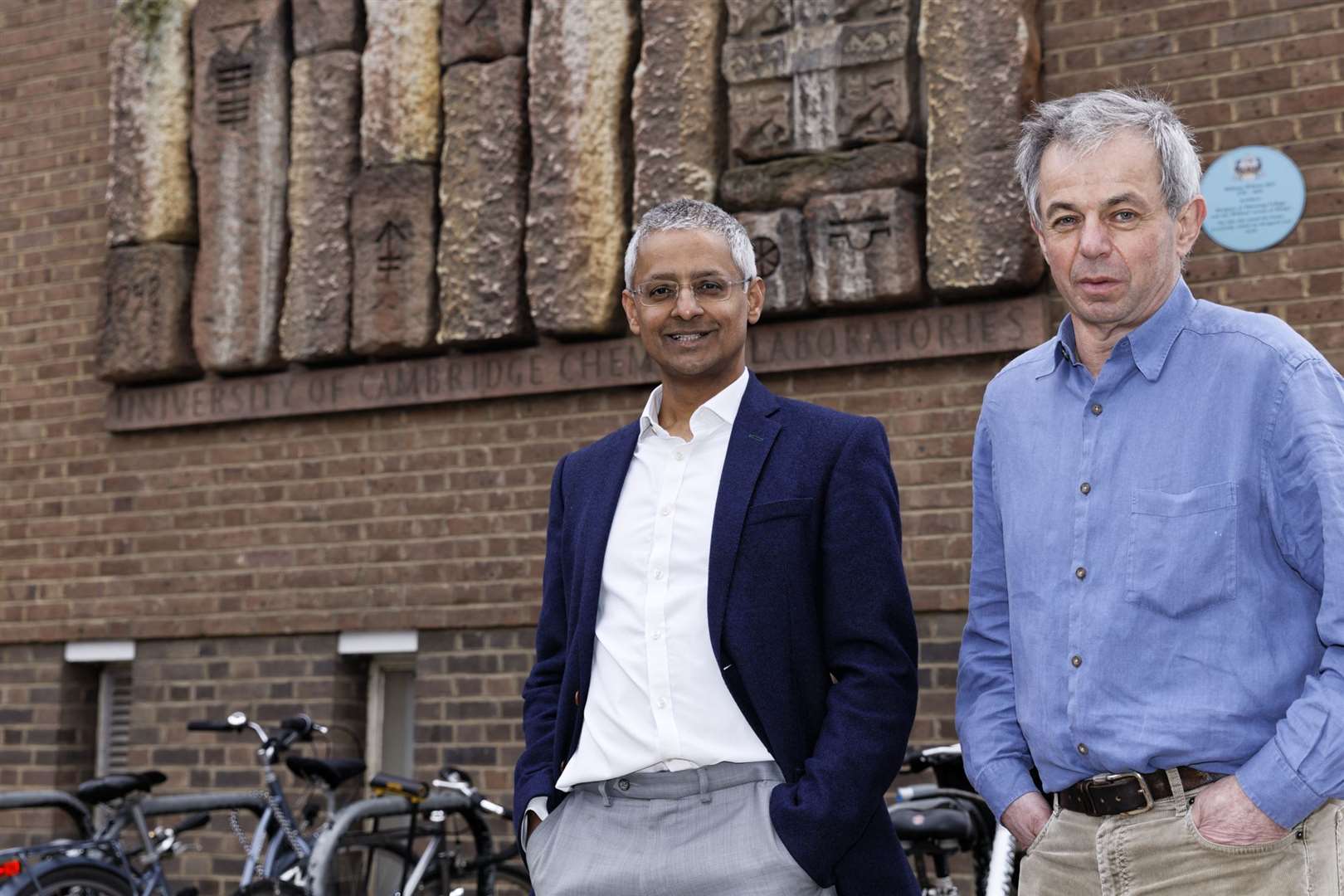
Dr Shankar Balasubramanian and Dr David Klenerman, co-founders of Solexa. Picture: Nathan Pitt / University of Cambridge
Two Cambridge researchers have been awarded the biggest and most lucrative prize in science for their work on dramatically improving the speed and reducing the cost of reading DNA.
Cambridge University chemists Sir Shankar Balasubramanian and Sir David Klenerman, shared the 2022 Breakthrough prize in Life Sciences with Pascal Mayer, the founder of the French firm Alphanosos, for creating next-generation genome sequencing (NGS).
NGS has transformed biology and medicine by enabling researchers to read human genomes a million times faster and at a fraction of the cost of early approaches. A top-end machine today can read a human genome in around an hour at a cost of $1,000. It took scientists 10 years and $3bn to read the first human genome.
The prize, worth more than £2m, was announced in San Francisco by the Breakthrough Foundation - which was set up by technology billionaires Sergey Brin, who co-founded Google; Priscilla Chan and Mark Zuckerberg, the cofounders of Facebook; Russian investors Yuri and Julia Milner; and Anne Wojcicki of 23andMe.
The Breakthrough Prize recognises ground-breaking discoveries in Fundamental Physics, Life Sciences and Mathematics, which includes helping study and identify viruses and could help prevent future pandemics.
As a result of the pandemic, the awards will actually be presented next year.
“These prizes go to a small number of people, but I’m delighted on behalf of the many who contributed to the work,” said Balasubramanian, who was in London for a family party when he heard he had won. “It was a real surprise, a call out of the blue.”
With NGS, researchers can go beyond just looking at the genome of a species to variations in the genetic makeup of individuals. This can lead to subtle differences being discovered in DNA, which can sometimes affect human biology and the onset of diseases.
During the Covid-19 pandemic, scientists used NGS to read and share the genetic code of the coronavirus. This was a crucial step for developing diagnostic tests and vaccines. NGS has since been used to monitor the emergence of troubling variants around the world.

A new five-storey laboratory and office building will rise at the Cambridge Biomedical Campus after plans for its construction were approved by councillors.
According to the World Mosquito Program, nearly 700 million people contract mosquito-borne illnesses each year, causing more than one million deaths.
The holidays are almost upon us and you might be thinking that it’s time to wind down your job hunting activities until at least the New Year. But why!?
The University of Cambridge has announced a five-year agreement with AstraZeneca and GSK to fund a new centre at the university, which aims to use AI to make medical discoveries, accelerate the development of precision medicine and develop new treatments.
Cambridge’s first 5G mobile private network will be constructed at the city’s Science Park, as part of a testbed due to go live in January 2021.
Demand for IT workers in Cambridge is high and that has caused tech salaries in the region to rise to become some of the highest in the whole of the UK. That’s one of the key findings to be revealed in Office for National Statistics (ONS) data compiled by job search engine Adzuna and entrepreneur network Tech Nation.
A new crop science centre, which hopes to sustainably improve farmers’ yields worldwide by translating research, has been opened in Cambridge.
With the telecommunications industry on Earth as competitive as ever, Nokia has announced that it is branching out into a new market, one that still doesn’t boast a single mobile phone tower: the Moon.
Researchers from the University of Cambridge have collaborated with 3D image analysis software company Lume VR Ltd to create Virtual Reality (VR) software that allows scientists to ‘walk’ inside cells.
Amazon is creating a new team at its Cambridge Development Centre to work on research and development of the company’s autonomous electric delivery robots.
A female entrepreneur from Cambridge is one of four winners of the second Women4Climate Tech Challenge 2020.
The human race’s continual quest to advance technologically knows no bounds. But the sad reality is that it often comes at the cost of natural environments. Important habitats destroyed, oceans full of plastic waste, the list goes on…