
Cambridge scientists develop robot chef that can cook and check seasoning

Looking for your next technology, science or engineering role? Maybe you’re just starting out in your career? Polytec is here to help you find the perfect position for you. Browse our current vacancies now >>> https://www.polytec.co.uk/jobs/

Scientists from the University of Cambridge have developed a robot chef that can not only cook food, but also taste test its creations to check if they hit the mark.

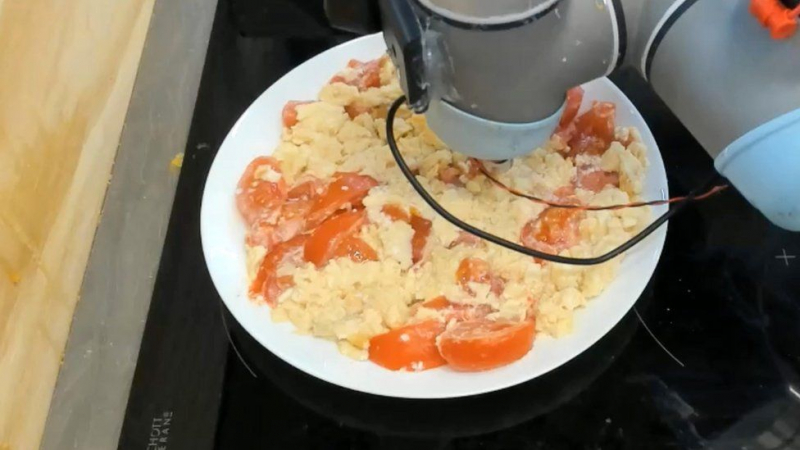
Having been taught previously how to cook an omelette, the robot chef has also learnt to taste food to see how salty it is. When given a plate of scrambled eggs with tomatoes, the robot chef sets to work tasting the food at different stages of the chewing process and creating so-called taste maps of the different dishes.

Now it’s important to understand why the robot chef tastes food at different stages of the chewing process. It’s because when we (humans) eat, our experience depends largely on where we are at in the process. So biting into a fresh, juicy tomato gives a unique flavour. As we then chew it further and it becomes mixed with digest enzymes, the flavour and experience changes.

The scientists who created the robot say it could lead to future developments in automated food preparation. Its 'taste as you go' approach improved the robot’s ability to quickly and accurately assess the saltiness of each dish.

The study authors say there was a significant improvement in the robot’s ability to assess saltiness over other electronic tasting methods, which can be time-consuming and only provide a single reading.

Grzegorz Sochacki from Cambridge’s Department of Engineering, the paper’s first author, said: “Most home cooks will be familiar with the concept of tasting as you go – checking a dish throughout the cooking process to check whether the balance of flavours is right.

“If robots are to be used for certain aspects of food preparation, it’s important that they are able to ‘taste’ what they’re cooking.”

The findings of the research are published in the journal Frontiers in Robotics & AI.

Check out the robot chef in action below:


Image credit: University of Cambridge

BioMed Reality invests £850m in two new Cambridge lab sites

September 13, 2021

Cambridge’s life sciences sector is set to receive a huge boost after BioMed Reality announced it is investing £850m building 800,000 sq. ft. of additional high-quality, purpose-built lab space in the city.

Cambridge semiconductor startup secures 1.5m in funding to develop innovative RF chip

August 23, 2021

A Cambridge semiconductor startup is looking to capitalise on the growing demand for sleek, region-specific smartphones with its innovative, frequency agile, tunable RF front-end chip.

13 semi-finalists announced in Cambridge Enterprise’s Chris Abell Postdoc Business Plan Competition

August 18, 2021

Cambridge Enterprise, the technology arm of the University of Cambridge, has announced the semi-finalists in the 2021 Chris Abell Postdoc Business Plan Competition.

More than £24m of funding for industrial studentships

August 11, 2021

Over 200 doctoral students will benefit from more than £24 million of funding to work on pressing research challenges with UK businesses through this year’s Industrial Co-operative Awards in Science and Technology studentships.

Plant-based spider silk could one day replace everyday single-use plastics

July 26, 2021

Single-use plastics could one day become a thing of the past, thanks to a new material developed by Cambridge scientists which imitates spider silk.

F1 to fund engineering degree at Cambridge University for underrepresented youngster

July 22, 2021

Formula One (F1) is to fully fund an undergraduate from an underrepresented background to study for an engineering degree at the University of Cambridge.

Cambridge scientists develop world first brain tumour urine and blood tests

July 14, 2021

Scientists in Cambridge have developed a world first test that can detect the presence of glioma, a type of brain tumour, using a patient’s urine or blood plasma.

New battery tech could see phones, laptops charging in five minutes or less

June 25, 2021

A battery breakthrough by scientists at the University of Cambridge could lower laptop, phone and other lithium-ion-powered gadgets charging time to five minutes or less.

PM Boris Johnson vows to make UK a scientific superpower

June 21, 2021

Prime Minister Boris Johnson has today (Monday 21st June) unveiled plans to cement the UK’s status as a “global science superpower”.

Chip maker Arm has co-founded a ‘deep tech’ accelerator in Cambridge

June 10, 2021

UK chip designer Arm has co-founded a new start-up accelerator in Cambridge, the aim of which is to help fledgling “deep tech” firms grow into the tech giants of tomorrow.

Team of Cambridge researchers and engineers forges new lithium-ion battery production methodology

May 25, 2021

team of researchers and engineers from Cambridge has developed a next-generation lithium-ion battery, designed to meet the density and cost requirements for future electric vehicles (EVs). Now, the team is embarking on the road to commercialization.

UK employment confidence continues to surge - CIPD

May 17, 2021

From the 17th of May, coronavirus restrictions across England, Wales and most of Scotland will ease, with indoor entertainment and attractions, hospitality venues and holiday accommodation all set to reopen. As a result, many employers are planning recruitment drives, with some looking to hire at the fastest rate in eight years, the Chartered Institute of Personnel and Development (CIPD) says.

Follow Us

Contact