Cambridge start-up secures £23m for its software-based approach to GPS
A Cambridge start-up has secured up to £23m of investment for its software-based approach to GPS positioning following a multi-round Series C funding round.
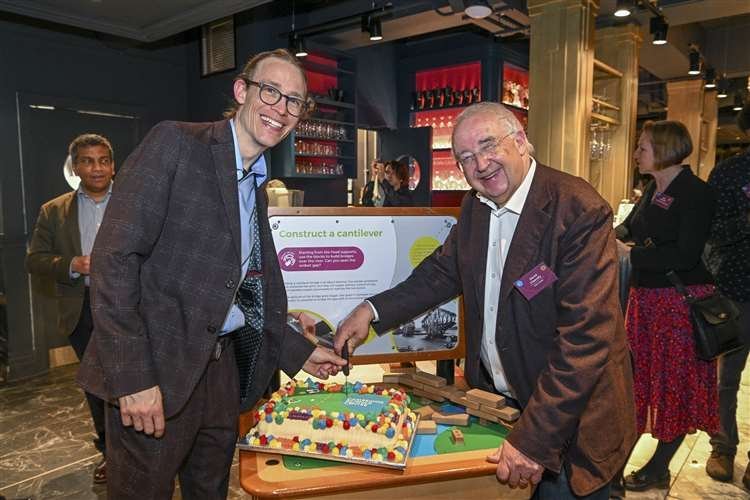
John Bull, CEO, Cambridge Science Centre, cuts the cake with David Cleevely. Picture: Keith Heppell
Cambridge Science Centre recently celebrated 10 years of inspiring children with Science, Technology, Engineering, and Mathematics (STEM) experiences.
Founded in 2013 by Dr Chris Lennard and Dr Katia Smith-Litiere, Cambridge Science Centre was established with the aim of making science accessible and enjoyable for people of all ages and backgrounds, and to inspire the next generation of scientists and engineers. The interactive museum features a wide range of science exhibits which enable visitors to explore and learn about different scientific concepts. The museum also hosts a variety of events and educational programs for schools and families, such as science shows, science clubs and science festivals.
To mark the 10-year birthday, an informal evening of cocktails, canapés and fun was hosted by Dr Jason Mellad – one of the centre’s key supporters – at The Lab bar on Regent Street in Cambridge.
At the event, guests were treated to a speech by Chair Dr David Cleevely, who highlighted the incredible transformations the centre has undergone, from changing locations to now offering community-based PopUpScience Centres.
"Ten years ago, the East of England was the only region in the UK without a Science Centre. Since starting CSC, we have reached dozens of underserved communities and welcomed hundreds of thousands of children, many of whom have had their prospects and ambitions changed for the better. With a fantastic board of Trustees and a great team led by John Bull, we are going to have an even greater impact in the future", David said.
CEO John Bull described the party as a “fabulous event”, adding: “It was attended by our supporters and our friends who’ve been part of this journey for the past 10 years and those that want to be part of it moving forward.
“It was an atmosphere of celebration, really, and I think one of the absolute highlights for me was when we were able to have two young people who are part of one of our rolling STEM engagement clubs from the local area come and talk about the impact that that’s made on their lives, and that really lit the room up. It was nice to see the impact that that’s had on them.”
Looking for your next technology, science or engineering role? Maybe you’re just starting out in your career? Polytec is here to help you find the perfect position for you. Browse our current vacancies now >>> https://www.polytec.co.uk/jobs/

A Cambridge start-up has secured up to £23m of investment for its software-based approach to GPS positioning following a multi-round Series C funding round.
A Cambridgeshire council is poised to become the first local authority in the UK to trial a 4-day working week.
Researchers from the University of Cambridge have successfully created model embryos from mouse stem cells which have a brain and a beating heart, as well as all the foundations for other bodily organs.
A team of scientists from Cambridge has developed floating "artificial leaves" which generate clean fuels from sunlight and water.
Employees who practise mindfulness are less likely to be bored at work and less likely to quit their jobs, a new study has found.
Online retail giant Amazon has announced that it plans to create 4,000 new UK jobs this year, despite the tech industry’s downturn.
Cambridge is the most “AI-ready city” in the UK, new research from a leading AI and analytics specialist has revealed.
A University of Cambridge electric vehicle (EV) charging spinout has secured £50m in funding to help it build a UK manufacturing plant.
A new 700,000 sq. ft. data centre campus in Cambridgeshire has taken a huge step towards becoming a reality after the site’s owners agreed a new funding package.
A group of students from Cambridge have made their way to the finals of The Big Bang UK Young Scientists & Engineers Competition, with their robotic seed planter.
Ten companies from across the UK have been given the opportunity to trial potentially game-changing prototype cybersecurity technology as part of a Digital Catapult initiative.
Scientists from the University of Cambridge have developed a robot chef that can not only cook food, but also taste test its creations to check if they hit the mark.