Cambridge launches free mobile planetarium to transform school science outreach
A new state-of-the-art planetarium from the University of Cambridge is set to reshape how pupils across the East of England experience space, offering an immersive learning tool that can be taken directly into classrooms.
Developed by the University’s Institute of Astronomy, the digital planetarium is believed to be the first free facility of its kind in the region, and one of only a handful available at no cost across the UK. Designed to support the AstroEast schools outreach programme, the system combines portability with advanced visual technology, enabling classes of up to 30 pupils to explore fully rendered 3D environments spanning millions of light years.
Dr Matt Bothwell, Public Astronomer at the Institute, said the technology marks a significant step-change in how astronomy is taught in schools. “The planetarium will transform our work in schools – it’s an entirely different way of engaging with the universe,” he said, noting that traditional outreach methods have changed little over the past decade.
The system allows pupils to experience space in a more tangible way, placing them in orbit around planets, on the surface of the Moon, or travelling between galaxies. “We now have the universe in a box,” Bothwell added.
AstroEast has already been delivering curriculum-linked workshops across the region, using astronomy to support numeracy and literacy development among Key Stage 3 pupils. However, according to Dr Hannah Strathern, Outreach Facilitator at the Institute of Astronomy, the addition of the planetarium represents a “game changer” for engagement.
“It will have such a huge impact on how we approach our outreach and work with schools, because we can take this amazing experience to them – and for free,” she said. “It’s awe-inspiring – as soon as you go into it you feel transported into space.”
The bespoke system was made possible through a philanthropic donation from Dr May Chiao, a former Research Fellow at the Cavendish Laboratory and Darwin College. Custom-built to meet the Institute’s requirements, the planetarium uses high-resolution data, including imagery from NASA’s Lunar Orbiter programme, to create detailed and interactive experiences.
Alongside its schools outreach work, the Institute of Astronomy continues to run public lectures and free stargazing events, which have attracted around 100,000 visitors since their launch in the 1990s.
Looking for your next technology, science or engineering role? Maybe you’re just starting out in your career? Polytec is here to help you find the perfect position for you. Browse our current vacancies now >>> www.polytec.co.uk/jobs
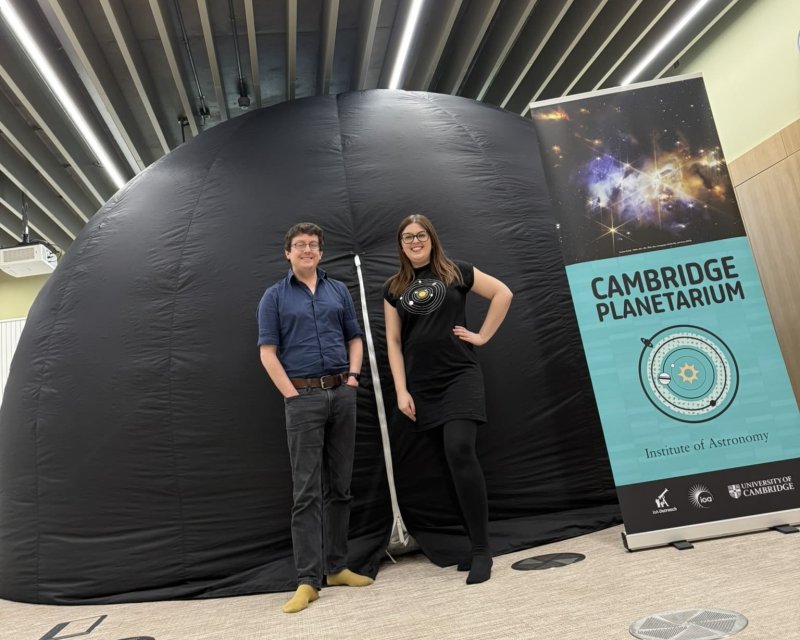
Image credit: University of Cambridge


