Cambridge Biomedical Campus will double in size in next 20 years – report
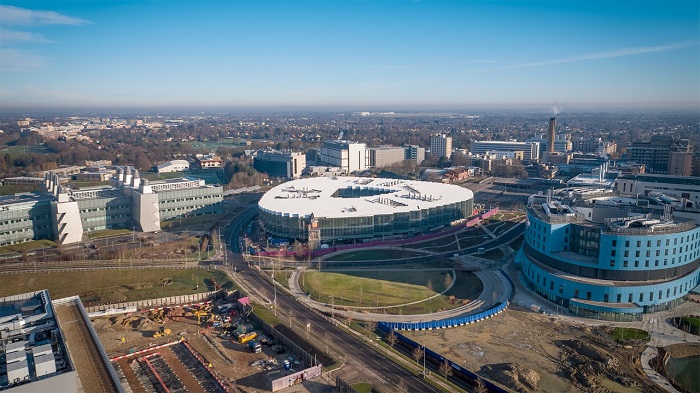

Image credit: Cambridge University Health Partners

Cambridge Biomedical Campus (CBC), the largest employment site in Cambridge, has published its emerging Vision for the future evolution and development, including plans to double its workforce over the next 20 years.

By 2041, the CBC will nearly double in size as the city “strains at its borders”. The campus, which is home to Cambridge University, AstraZeneca, and Addenbrooke's Hospital, will increase its workforce from more than 20,000 to between 34,000 and 40,000.

Outlined in a report setting out the vision for the site as a healthcare and innovation hub, the campus’s growth will include a new cancer hospital and a new children’s hospital. Furthermore, the report also says there should be spaces such as cafés or gyms for people to meet and build relationships in, as well as hotels and conferencing facilities.

‘Even taking a moderate view’, the report says the need from research and development businesses would require expansion of between 100,000 and 150,000 square feet gross internal area per year, which would equate to almost 20,000 new individuals.

The report highlights that despite there being more than 30 science parks and hubs within 10 miles of Cambridge city centre, the city is ‘straining at its borders. It adds that science parks are full, with vacancies in high demand from businesses globally, all keen to tap into the ‘talent that Cambridge cultivates’.

Jan Löwe, Director at the MRC Laboratory of Molecular Biology, said: “The CBC is an incredibly unique location, with the power of complementary institutions co-locating together, helping us to translate world-leading science into healthcare and jobs for local people. We should never take this for granted, and so it’s hugely important that we set a course for this work to continue to prosper.

“The CBC will only continue to innovate, succeed and deliver by integrating more closely with Cambridge and local communities. We hope that our conversation with local groups demonstrates our commitment to this course. We want to grow in a way that delivers benefits beyond the great work of CBC partners, creating a welcoming environment for everyone.”

If you want to find out more and/or feed back your views on the CBC’s vision, you can do so here: https://www.cbc-vision.co.uk/

Cambridge researchers develop wireless device that makes clean fuel from Co2 and sunlight

August 28, 2020

Researchers from the University of Cambridge have developed a standalone, wireless device that can convert sunlight, carbon dioxide and water into a carbon-neutral fuel. The researchers say the breakthrough is a massive step towards achieving large-scale artificial photosynthesis

Scientists Use Orange Peel to Extract Valuable Metals from Spent Lithium-Ion Batteries

August 28, 2020

You could be forgiven for thinking that lithium-ion batteries — like the ones found in smartphones, laptops, electric mobility vehicles and more — are no longer much good once they have lost their charge. However, the reality is they still contain lots of valuable metals, such as lithium, cobalt, manganese and nickel, which can be recovered and recycled.

UK and Japanese Engineers Shatter Internet Speed Record

August 25, 2020

Engineers from the United Kingdom and Japan have set an incredible new Internet speed record of 178 terabits per second (Tb/s). That’s 178,000,000 megabits a second, fast enough to download the entire Netflix library in the blink of an eye!

Introducing Theia: The Handheld Robotic Guide Dog

August 6, 2020

Guide dogs provide visually impaired individuals with many benefits. However, they aren’t always appropriate, with cost, space and allergies all potential barriers to ownership. But a new technology being developed at Loughborough University could see all a guide dog’s functions channelled into a handheld, robotic device for the visually impaired.

The Tiny Camera That Can Take 3D Pictures Inside Your Blood Vessels

July 24, 2020

A team led by the University of Adelaide and the University of Stuttgart has used 3D micro-printing to create the world’s smallest imaging device, capable of going inside blood vessels.

JLR and Cambridge University Develop Touchless Touchscreen Technology

July 24, 2020

Jaguar Land Rover (JLR) and the University of Cambridge are collaborating on the development of a new contactless touchscreen technology, which is designed to promote safer driving and reduce the spread of germs, bacteria and viruses in a post-COVID world.

Huawei Given Nod for 1bn Cambridgeshire R&D Facility

June 29, 2020

Huawei has been given the go-ahead by South Cambridgeshire District Council to build a £1bn research and development facility nine miles outside of Cambridge. Voting nine to one in Huawei’s favour on Thursday 25th June, councillors approved planning permission for the 53-acre site in Sawston, which Huawei will develop with a view to moving its operation from Ipswich to Cambridge.

Delivery Drones Could Quadruple Their Effective Range Using Buses Stanford Study

June 26, 2020

How do you extend the range of a drone? Put it on a bus, of course! Now, while you might be thinking that we’re joking, that’s actually one of the findings to come out of new research from Stanford University.

University Of Cambridge Announces AI & Machine Learning Accelerator Programme

June 25, 2020

In an attempt to equip non-Computer Science students with valuable machine learning and artificial intelligence (AI) skills, the University Of Cambridge has announced a new accelerator programme.

UK Leading the World in Online Safety Tech

June 9, 2020

Online safety tech is helping to make the Internet a safer place for millions of people and the UK is leading the way when it comes to innovation. Indeed, companies based in UK cities including London, Leeds, Cambridge and Edinburgh make up 25% of the global market share for safety tech products, an independent report reveals.

What Will Office Life Be like in a Post-COVID World?

June 9, 2020

Right now, many offices around the UK are sitting empty while staff are furloughed or working from home. But in time, the COVID-19 crisis will end and the lockdown situation will be eased and that means people will start, in theory, returning to their places of work.

The ground-breaking Terminator rubber that can heal itself

June 9, 2020

How frustrating is it when you’re driving along in your car and you suddenly get a puncture? It’s inconvenient at best and an absolute nightmare at worst, especially if you have no idea how to change your tyre!

Follow Us

Contact